
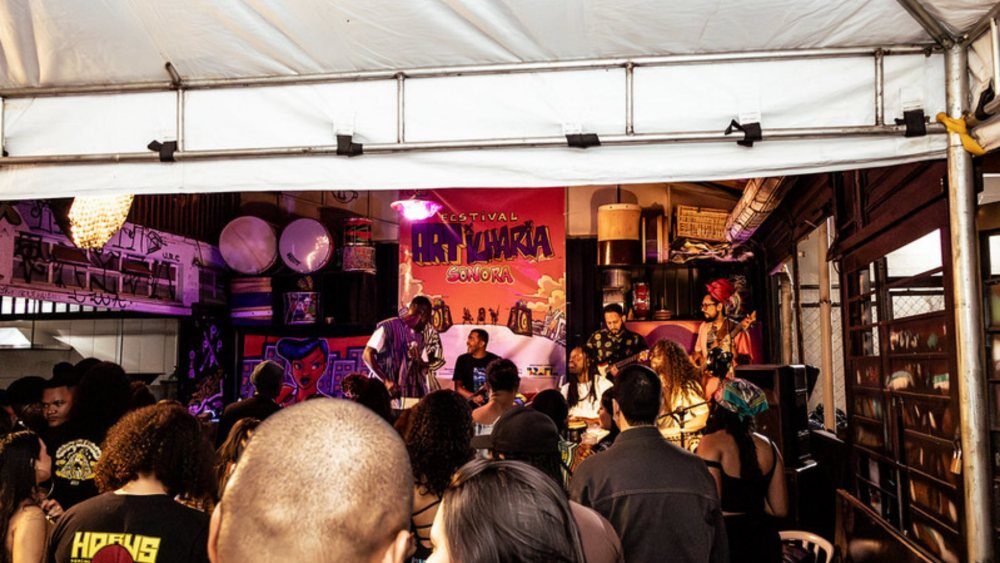
Brazilian rhythm is a wide field of local traditions — many beats, many family trees — shaped by African and Indigenous knowledge, Portuguese colonisation, forced migration, regional exchange and continual reinvention. Samba de roda and samba chula in Bahia, jongo in the Southeast, maracatu in Pernambuco, carimbó in Pará, capoeira toques, baião, frevo and many other forms each belong to their own communities and histories. The useful questions are where a rhythm is practised, who carries it, and what it asks people to do together.
A map with many origin stories
“Brazilian rhythms” is a practical umbrella term; the traditions it gathers descend from many different sources. Some names describe music and dance together. Some belong to a procession, game, religious house or seasonal celebration. Others became recording genres or Carnival arrangements. A word such as samba can itself cover several independent forms.
Across that variety, certain ways of making music return: call and response, layered percussion, repeating timelines, bass parts that interlock, and a close relationship between sound and movement. Every tradition keeps its own identity; the recurring features are clues that Brazil has long been a meeting place where communities preserved knowledge, adapted instruments and made new forms under very different conditions.
The African diaspora is central to this history. Enslaved Africans were forcibly carried across the Atlantic, and their descendants maintained and remade languages, beliefs, movements and musical practices in the Americas. Indigenous knowledge and local environments also shaped Brazilian instruments, dances and ways of gathering, while Iberian forms contributed languages, verse structures and instruments. What emerged is a set of living Brazilian practices, shaped by all of these inheritances and still in conversation across the Atlantic.

Early crossroads: circles, processions, work and play
Several traditions belong in an early map of Afro-Brazilian rhythm, but they should not be presented as if they all appeared at once or followed one neat chronology.
- Samba de roda and samba chula are closely associated with Bahia’s Recôncavo. Samba de roda brings music, dance and poetry into a circle; chula names a related local form with its own singing and performance conventions. UNESCO describes samba de roda as a practice developed in the Recôncavo with strong African-descended foundations and Portuguese elements. Migration later carried Bahian practices into conversation with the urban sambas of Rio.
- Lundu and maxixe belong to different periods in the long formation of Brazilian social dance and popular music. They help show how African-derived movement and rhythm entered public and commercial stages, though their precise genealogies are debated.
- Jongo and batuque are broad or locally variable terms. IPHAN describes Jongo in the Southeast as an Afro-Brazilian form joining drums, collective dance and sung language, historically sustained in rural and later urban communities. Batuque may name a specific local practice or be used more generally, so it always needs regional context.
- Maculelê and capoeira are embodied practices with music, movement and their own rhythmic vocabularies. Capoeira toques such as Angola and São Bento Grande organise the game; they are not simply song styles detached from the roda.
- Maracatu is another family of traditions. Maracatu Nação, or baque virado, is rooted in the Recife region and brings percussion, procession, courtly figures and Afro-Brazilian religious relationships together. Maracatu Rural, or baque solto, is a distinct Zona da Mata tradition. One should not be treated as the early version of the other.
These practices survived because people kept rehearsing, celebrating, teaching and changing them. Continuity can include new instruments, urban migration and new stages without erasing community ownership.
Regional families across a large country
A regional map makes the scale easier to hear, provided its borders stay porous. Musicians travel; records and radio circulate; communities migrate; Carnival groups borrow and answer one another. Treat the following families as starting points.
North and Amazonian forms
Carimbó is a music-and-dance expression of Pará whose name also refers to its drum. IPHAN’s registration describes a practice with African, Indigenous and Iberian influences, sustained through social gatherings, song, choreography and oral transmission. Traditional ensembles centre drums and may add maracas, flutes or other instruments; later forms incorporated amplified instruments without making the community practice disappear.
Marabaixo in Amapá and the many forms of boi-bumbá and bumba meu boi add further combinations of percussion, verse, dance, costume and dramatic action. The boi traditions vary greatly by place: Maranhão’s cultural complex is not identical to the festival forms heard in Amazonas. Toada, likewise, is a word that several different settings use for their own song forms.
Pernambuco and the wider Northeast
Pernambuco alone holds several powerful families. Alongside maracatu are coco, with sung response, dance and percussion; frevo, the fast Carnival form of Recife and Olinda; and rural traditions carried by pífano bands. Across the Northeast, baião, xote and xaxado became closely associated with the broad world of forró. Accordion, zabumba and triangle are a familiar trio in that world, but local ensembles and dance practices remain more varied than the standard stage image suggests.
This is why a list of genre names can mislead. Coco names a social event, a way of dancing, a repertoire and a network of musicians as well as a drum pattern; forró, in the same way, reaches well beyond a recording category.
The Southeast and urban samba families
In Rio de Janeiro, partido-alto, samba de terreiro and samba-enredo are recognised as distinct matrices of urban samba. Their histories include Bahian migration and the work of Black communities in Rio, but they developed their own institutions, neighbourhood ties and performance rules. Samba-enredo serves the narrative parade of a samba school; partido-alto foregrounds verse and improvisation; samba de terreiro names the social music cultivated in samba-school spaces beyond the parade theme.
Jongo remained present in the Southeast as well, particularly in communities of Rio de Janeiro, São Paulo, Minas Gerais and Espírito Santo. Its drums, circle and sung points make a different social world from a samba-school bateria, even where musicians recognise shared Afro-Brazilian histories.

The Bahian branch: from the Recôncavo to the bloco afro
Bahia offers a particularly clear example of continuity without sameness. In the Recôncavo, samba de roda and chula are circle-based practices of music, dance and poetry. In Salvador, other samba forms developed in neighbourhoods, terreiros, Carnival associations and popular stages. The lines between them are routes of exchange, travelled in both directions.
Religious communities are part of that landscape, but it would be wrong to say that every Bahian rhythm began in Candomblé. Sacred toques belong to the terreiro and to the people authorised to carry them. Popular forms such as the street expression of ijexá have relationships with Afro-Brazilian religious music, yet they operate in different contexts. The sibling guide to percussion and Candomblé gives that subject the respectful space it needs.
During the twentieth century, afoxés, blocos afro and percussion groups made new public languages for Black identity in Salvador. Ilê Aiyê and Olodum are central to that story. Samba-reggae emerged in this world in the 1980s, bringing samba percussion into conversation with Caribbean reggae and organising pitched surdos into a powerful ensemble voice. Read the dedicated samba-reggae guide for its history and the field guide to Bahian drums for the instruments themselves.
The Bahian branch also includes samba afro, samba duro, pagode baiano and many local group vocabularies. These labels can overlap, and musicians do not always use them in the same way. What remains audible is the importance of layered parts: low drums hold and answer the pulse, bells or other high voices mark a timeline, and lead instruments call changes or improvise.
Diaspora means memory, transformation and exchange
The Atlantic frame matters because it explains why percussion appears across social, festive and religious life from West and Central Africa to the Americas. People who endured forced displacement carried knowledge: they rebuilt institutions under violence, encountered other African peoples and Indigenous communities, and created forms suited to new places, remaking their rhythms as they went.
That is why similarities between Brazil, Cuba, the Caribbean and African regions are an invitation to study; the claim that two genres are “the same” cuts that study short. A bell pattern may resemble another across the Atlantic while its name, function and meaning differ. Samba is Brazilian; its African inheritance is real, but it cannot be reduced to one African source. The most honest language is relationship: memory survives through change.

Rhythm as community practice
One idea deserves to stay at the centre of any map of Brazilian rhythm: these arts are larger than technique. IPHAN describes intangible heritage through knowledge, celebrations, expressive forms and the places where collective practice happens. In that sense, rhythm may organise dance, worship, work, play, procession, memory or belonging as well as sound.
Learning a pattern from a recording can be a beginning, but it does not make someone the owner of a tradition. Context comes from listening to practitioners, learning what the music is for, naming its community and accepting that some knowledge is not public instruction. Oral transmission is a rigorous method in its own right, built through observation, repetition, correction and relationship.
How to keep listening
Choose one tradition and stay with it long enough to hear separate voices. Find the bass part, then the timeline, then the call and response. Watch how movement sits against the pulse. Compare two recordings from the same community before comparing different regions. If you want to move from listening to practice, continue with six steps for learning Brazilian percussion. For the places and living culture around many Bahian forms, the guide to culturally curious Salvador is the natural companion.
Sources & further reading
- UNESCO — Samba de Roda of the Recôncavo of Bahia, Representative List of the Intangible Cultural Heritage of Humanity.
- Instituto do Patrimônio Histórico e Artístico Nacional (IPHAN) — registration and safeguarding materials for Carimbó, Jongo no Sudeste, Maracatu Nação, Matrizes do Samba no Rio de Janeiro, Roda de Capoeira and the Complexo Cultural do Bumba Meu Boi do Maranhão.
- Crook, Larry — Brazilian Music: Northeastern Traditions and the Heartbeat of a Modern Nation.
- Gonzalez, Lélia — “A categoria político-cultural de amefricanidade.”
