
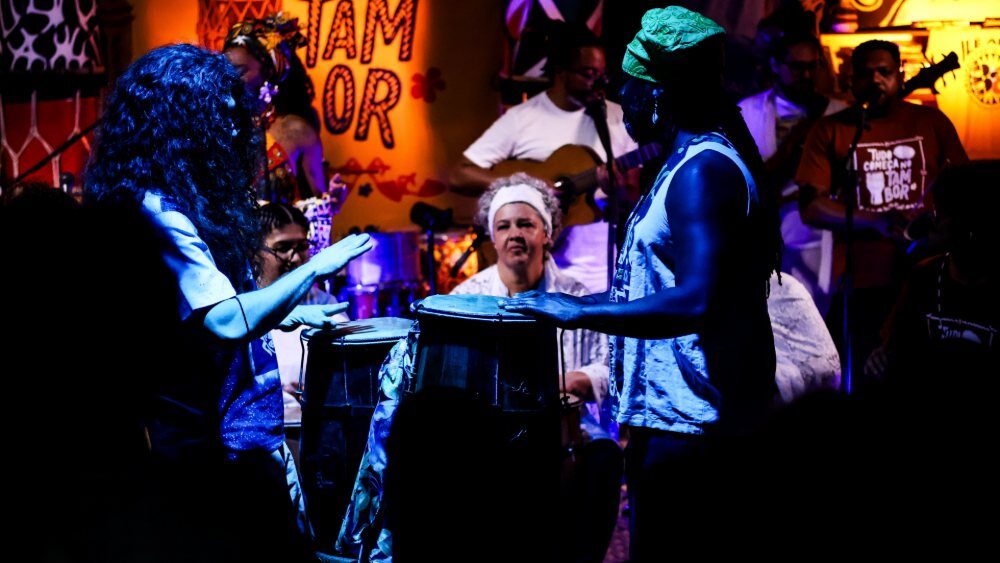
Bahian percussion works as a conversation between different registers. Surdos carry the bass pulse; caixas and repiques give the groove edge and direction; timbaus and other hand drums add tone and improvisation; agogôs, shakers and scrapers make the timeline audible. The atabaque belongs first to Afro-Brazilian religious traditions but also has a wider technical and historical presence. Each instrument makes most sense as one voice inside an ensemble.
How to listen to a Bahian percussion section
A percussion group can look like a wall of drums, but the arrangement is closer to a set of interlocking voices. Low instruments establish weight and direction. Mid-range drums maintain texture. Higher voices mark subdivisions, call changes or leave space around the pulse. Bells, shakers and scrapers can sound small beside a surdo, yet their repeating patterns help the whole group locate the cycle.
The same instrument does not have one universal part. A surdo in samba-reggae has a different relationship to the groove from a surdo in a Rio samba school. A pandeiro can support samba de roda, choro, pagode or capoeira with different accents. An atabaque may be played by hand in one setting and with sticks in another. Names and sizes also change between regions and groups.
It helps to begin with three questions: What register does this instrument occupy? Does it repeat a supporting pattern or lead transitions? What cultural setting gives that part its meaning? The related guide to the rhythms of Brazil places the instruments inside the styles they serve.

The low end: surdo
The surdo is a cylindrical bass drum played with a padded mallet, usually with the free hand or a second mallet controlling resonance according to the style. Modern shells may be wood or metal and heads may be synthetic or animal skin. Diameter, depth and tuning determine where a drum sits in the bass range, but ensemble convention matters more than a fixed measurement.
In samba-reggae, several surdos at contrasting pitches play complementary parts. A lower voice can establish the main landing point, another answers it, and a higher voice may move more freely around the cycle. Together they create the rolling bass movement associated with Salvador’s blocos afro. Our guide to samba and samba-reggae follows the history behind that sound.
Surdo players also shape duration. Muting a head makes a short, defined note; allowing it to ring opens space through the ensemble. The musical effect comes from that control as much as from volume. A bass drum that rings through every gap can hide the patterns it is supposed to support.
The cutting voices: caixa, repique and tamborim
The caixa is a snare drum. Its wires create a bright, sustained texture that can bind a large group together. Some parts emphasise a steady subdivision; others use syncopated figures. The drum’s marching-band ancestry is visible in its construction, but Brazilian ensembles developed their own ways of carrying, tuning and phrasing it.
Repique and repinique are related names used for high, projecting drums. In a bloco, a repique can cut through the surdos to call an entrance, answer a phrase or signal a break. Playing technique varies: two flexible sticks are common in some Bahian settings, while one stick and one hand appear in other samba traditions. Smaller Bahian variants, including the bacurinha, occupy an even higher register.
The tamborim is a shallow handheld drum with a piercing sound. It is especially prominent in Rio samba, though it also appears in Bahian forms. A single or multiple flexible beater can articulate fast patterns above the ensemble. Despite the similar name, it is not a small timbau: its construction, holding position and musical role are different.

The hand-drum voice: timbau
The timbau, also called timbal, is a tall, tapered hand drum with a bright, open tone. Contemporary instruments commonly use a lightweight shell and a mechanically tensioned synthetic head. Players combine bass tones, open sounds, slaps and muted strokes, allowing one drum to hold a repeated phrase and project short solo responses.
The instrument became a signature of modern Bahian percussion through samba duro, samba junino, Timbalada and the wider axé-music era. Different musicians describe its earlier development in different ways. Whoever first shaped it, Salvador players turned the timbau into a powerful lead and ensemble voice.
Opanijé teacher Adson “Pai de Santo” Junior played timbau with Banda Timbalada from 1996 to 2000. That experience belongs to a larger oral teaching line: beyond the catalogue of strokes, timbau technique is learned as phrasing, posture, tone and response inside a group.
Atabaque: construction, context and care
The atabaque is a tall, single-headed hand drum built from a wooden shell and an animal-skin head. Traditional construction can use rope and rings to create tension. Other drums use wooden pegs or metal hooks and nuts. The choice among these systems runs deeper than old versus new: makers weigh sound, tradition, repairability and the community that will use the drum.
Atabaques appear in capoeira, samba de roda and other public traditions, but their most important Bahian context is sacred. In many Candomblé houses, a set of three is named rum, rumpi and lê, from lower to higher register, with the large rum taking the leading voice. Technique and naming vary by religious nation and lineage. In some traditions, prepared sticks known as aguidavis are used; in others, hands or a combination of hand and stick are heard.
Those details are offered here as cultural context. Consecrated instruments and sacred toques belong to the terreiro and are learned through its authority. The guide to percussion and Candomblé explains why public education should stop at that boundary.
Artisans are essential to the sound. Building a shell from staves, seating a skin, fitting rings and balancing tension all require musical judgement. Natural heads respond to humidity and temperature; rope systems settle; wooden shells move. A maker or experienced player hears problems that a list of dimensions cannot show.
Bells, shakers and scrapers
The agogô consists of one or more metal bells with contrasting pitches. A repeating bell pattern can act as a timeline: other parts orient themselves around it even when they do not strike on the same beats. A related single bell, the gonguê, is strongly associated with maracatu in Pernambuco. The names are sometimes treated as interchangeable in casual lists, but their shapes, settings and playing practices differ.
The ganzá is a tubular shaker, commonly filled with beads or small particles. The caxixi is a woven basket shaker with a hard base and is closely associated with the berimbau, though it appears elsewhere. The xequerê or agbê surrounds a gourd with a bead net. Each can maintain a continuous subdivision while producing subtle accents through angle and movement.
A reco-reco produces sound by scraping a stick over ridges. It can be made from bamboo, wood, metal or other materials. In samba de roda, a kitchen plate scraped or struck with a knife became another distinctive high, metallic voice. These instruments show how musical function can outlast any one material: what matters is the repeated texture and the way it sits against the pulse.
Pandeiro: one frame, many sounds
The pandeiro is a handheld frame drum with a single row of metal jingles. Traditional heads may be animal skin; synthetic heads are common on modern instruments. The supporting hand tilts and rotates the frame while the playing hand combines thumb strokes, fingertips, slaps and muted touches.
A good pandeiro part can imply several instruments at once: a low thumb tone suggests bass, fingertips articulate the middle, a slap creates an accent and the jingles fill the subdivision. This is why the instrument works in settings as different as samba, choro, capoeira and coco. It is easy to carry and hard to master: controlling balance and resonance takes time.

Instruments that clarify the wider map
Not every important Brazilian drum is Bahian, and comparison helps prevent a national glossary from collapsing regional difference. The alfaia is a large, double-headed, rope-tensioned drum central to maracatu-nação in Pernambuco. The zabumba is a double-headed bass drum strongly associated with forró, played with a heavier beater on one head and a thin switch on the other.
The cuíca is a friction drum: rubbing a stick attached through the head creates its vocal, sliding sound while pressure on the skin changes pitch. The caxambu and related drums belong to jongo traditions in southeastern Brazil. The tambor de crioula family belongs to Maranhão, where long, single-headed drums are traditionally warmed by fire and played with dance and song. Their presence in an instrument list does not make them interchangeable with Salvador percussion.
That regional care applies inside Bahia too. A Candomblé house, a capoeira roda, a samba de roda gathering, a bloco afro and a stage band may all use drums, but they organise authority, repertory and participation differently. The Salvador guide gives more context for encountering the city’s public music without confusing every drum gathering with Carnival.
How the voices fit together
Start from the lowest repeating pattern. Once the surdo cycle is clear, listen for the caixa or shaker subdivision. Then locate the bell, repique calls and hand-drum phrases. This bottom-up approach turns a dense recording into a set of intelligible parts.
In practice, a player must also listen sideways. The same written pattern can rush, drag or lose its swing if it ignores the neighbouring voices. Good ensemble playing involves consistent tone, controlled volume and space. A support part makes its music through repetition; that steadiness gives the lead voice somewhere to go.
For a structured path, the guide on learning Brazilian percussion begins with body pulse, listening and one complete part before adding speed. Opanijé’s percussion learning page shows how that learning takes shape in practice. In either case, the goal is to learn who and what the instrument serves, which is a deeper question than how loudly it can speak.
Sources & further reading
- Crook, Larry — Brazilian Music: Northeastern Traditions and the Heartbeat of a Modern Nation.
- Béhague, Gerard — writings on Afro-Bahian percussion and Candomblé music.
- Field documentation of Salvador’s blocos afro and terreiro traditions.
