
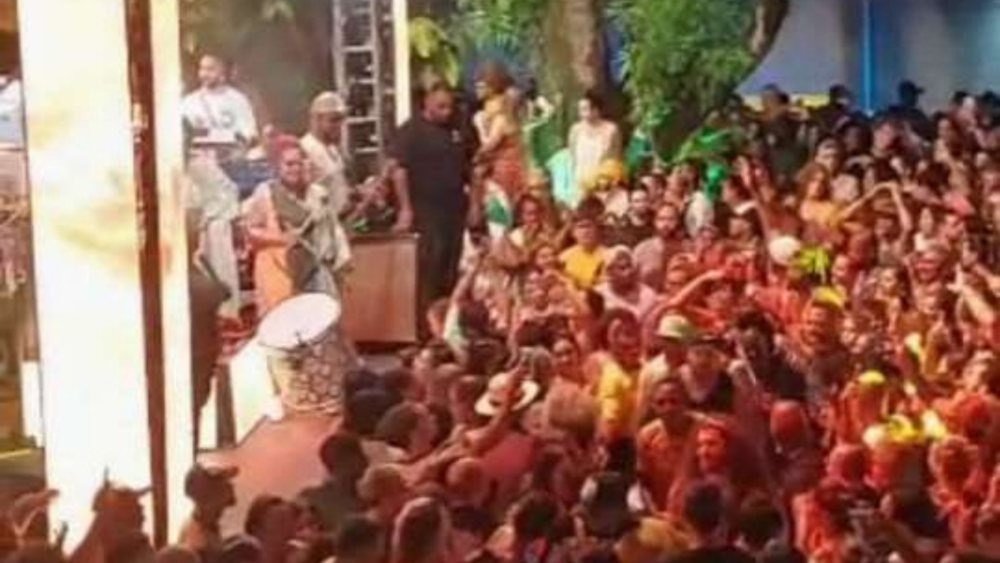
Samba is a broad family of Brazilian music, dance and community practice shaped above all by African-descended people. Its histories run through Bahia’s Recôncavo and samba de roda, through the urban sambas of Rio de Janeiro and Salvador, and into later Bahian forms such as samba junino, bloco afro music and samba-reggae. Samba-reggae took shape in Salvador in the 1980s, joining samba’s swing to reggae and other Caribbean influences through interlocking bass drums, snares and lead percussion.
Samba is a family of many forms
The word samba covers related but distinct traditions. A circle of singers, dancers and musicians in the Recôncavo Baiano does not sound like a Rio samba school on the parade avenue. A small group accompanying a singer does not work like a large Bahian bloco moving through the street. The instruments, tempo, movement and social setting change, yet each form depends on people sharing a pulse and responding to one another.
That variety is why a single birthplace story can mislead. Samba’s deepest formation belongs to the African diaspora in Brazil, and it developed through many communities and exchanges. Bahia is central to that history, especially the Recôncavo around All Saints Bay. Rio is also central to the growth of urban samba, recording and the samba-school tradition. Other regions formed their own vocabularies. The companion guide to the rhythms of Brazil follows more of those regional branches.
Samba has also lived through dance, food, religious community, neighbourhood association and Carnival. Treating it only as a musical genre misses the social space that allowed people to carry songs and rhythms between generations. Much of that knowledge was maintained orally: a part could be learned by watching a player, entering the circle, listening to the chorus and gradually understanding when to answer.

Bahia, the Recôncavo and samba de roda
Salvador was colonial Brazil’s first capital and a major port in the transatlantic slave trade. Across Bahia, people brought from different parts of West and Central Africa preserved and reorganised languages, beliefs, music and forms of association under violent conditions. Their descendants made new Afro-Brazilian traditions in dialogue with Indigenous and European elements. Samba emerged within that long, unequal history.
The Recôncavo Baiano surrounds All Saints Bay and includes towns such as Santo Amaro and Cachoeira. The region is closely associated with samba de roda, a circle form documented in the nineteenth century and sustained into the present. Singing usually moves between a lead voice and chorus while clapping fixes the shared pulse. Dancers enter the circle in turn. Instrumentation varies by place and occasion, but pandeiro, atabaque, agogô, reco-reco, caxixi, viola and the sound of a knife played across a plate can all belong to its sound world.
The circle matters as much as the list of instruments. There is no distant audience in the usual stage sense: participants support the chorus, clap, watch, answer and make room for the dancer. A short melodic phrase can be repeated and transformed through timing, vocal response and movement. The music is collective even when one singer, dancer or instrumental voice comes forward.
Samba de roda has shared social ground with capoeira and Afro-Brazilian religious communities, but those relationships should not be flattened into a single origin formula. Practices differ between communities, and sacred material is not interchangeable with public entertainment. Our guide to percussion and Candomblé explains that boundary and why religious repertoire belongs first to the terreiro.

From the circle to urban samba
After slavery, Black Bahian migration helped carry religious, culinary and musical practices to Rio de Janeiro. The home of Tia Ciata, a Bahian-born religious leader and community figure, is widely remembered as one of the important meeting places in early Rio samba history. Musicians gathered in a world where Afro-Brazilian celebration was frequently policed, so homes, yards and community networks offered essential space.
Urban samba changed as it met string accompaniment, new song forms, radio, theatre, recording and Carnival organisation. In Rio, the samba schools created large percussion sections and parade repertories. Surdos established the low pulse; caixas, tamborins and other voices built dense layers above it. Songwriters and small ensembles developed other forms, including partido-alto, samba-canção and, later, pagode. These histories developed side by side, and older forms kept their own life as newer ones emerged.
Bahia had its own urban singers and composers. Riachão, Batatinha and others wrote about work, affection, inequality and the daily life of Salvador. Their music was connected to local memory while also participating in a national world of broadcasts and recordings. At the same time, samba de roda continued in the Recôncavo and in Bahian communities. Traditional and commercial forms influenced one another without becoming identical.
This movement between local practice and public media is a recurring feature of samba. A neighbourhood rhythm can enter Carnival, a recorded song can travel back into community repertory, and an instrument can find a new function in another ensemble. The result is a living family whose branches sometimes overlap and sometimes insist on their regional difference.
Salvador’s street branches
In twentieth-century Salvador, samba duro and samba junino developed in neighbourhood groups associated with the June festival season. Accounts from musicians describe ensembles built around timbal, repique or bacurinha, tamborim and surdo. These groups turned percussion into a mobile street language: a lead voice could call a break, bass drums held the body of the groove, and higher drums answered above it.
The exact lineage between samba de roda, samba duro and later Carnival styles is more complicated than a simple family tree. Musicians moved between settings, and religious, neighbourhood and commercial influences met in different proportions. It is safer to hear samba junino as one important part of Salvador’s urban percussion history than to label it the single source of everything that followed.
The rise of the blocos afro changed the scale and public meaning of Bahian Carnival. Ilê Aiyê, founded in 1974 in Liberdade, is widely recognised as the first bloco afro. It asserted Black beauty, history and political presence in a Carnival society marked by racism. Other groups developed their own identities, repertories and visual languages. Their parades made percussion a vehicle for collective memory as well as celebration.
Anyone planning to hear these traditions in place should remember that Salvador’s culture belongs first to the people who live it. Rehearsals, religious spaces and neighbourhood events have their own rules. The culturally curious guide to Salvador offers a practical introduction to listening, visiting and asking permission respectfully.

How samba-reggae took shape
Samba-reggae emerged within this Afro-Bahian Carnival world in the 1980s. The name points to an audible meeting: samba-derived percussion and movement joined reggae’s emphasis on the backbeat, alongside other Caribbean references circulating through the Black Atlantic. Out of that meeting came a new Bahian ensemble language, built around the way many drums could interlock.
Olodum, founded in 1979 and based in the Pelourinho, became an international ambassador for the style. Percussionist and musical director Neguinho do Samba is widely credited with shaping its characteristic approach. The low drums were organised in contrasting pitches and complementary phrases, while caixas and repiques supplied the sharper grid and calls. This made a large percussion section sound both massive and articulated.
By the 1990s, recordings and international collaborations had carried Olodum’s sound far beyond Bahia. That visibility mattered, and samba-reggae stayed a local, collective practice even as it entered global pop. Its musical grammar remained connected to bloco rehearsals, Carnival processions and the social projects through which groups taught younger players.
What samba-reggae sounds like
The foundation is a family of surdos, bass drums tuned to different relative pitches. One part establishes the main pulse; another answers; a higher or more mobile bass voice can add variations. Naming and exact division differ between ensembles, so it is better to listen for function than assume every group uses the same numbered system.
Above the bass, the caixa creates a continuous snare texture. The repique or repinique can announce entries, signal breaks and project short phrases. A timbau adds the wider vocabulary of a hand drum, from low open tones to sharp slaps. Some ensembles use it centrally; others do not. The broader field guide to the drums of Bahia explains how these voices are built and how their roles change between traditions.
Reggae influence can be heard in the weight placed around the backbeat and in the spacious, rolling feel between the parts. Yet the groove is produced collectively. The full style comes to life when the bass voices, snare layer, calls and dancers settle into the same cycle.
Samba-reggae and the wider samba family
Samba-reggae is often compared with Rio’s samba-enredo because both can involve large Carnival percussion sections. Rio ensembles are generally associated with a faster parade drive and a different balance of surdo, caixa and tamborim parts. Samba-reggae often feels heavier and more open, allowing the contrasting bass pitches and backbeat to register clearly. Those tendencies are useful listening cues, though individual groups often depart from them.
The broader view makes the distinction easier. Samba de roda centres a circle, chorus and dance exchange. Urban song forms place more weight on melody, harmony and lyric. Samba-school percussion is organised for a parade repertory. Samba junino and samba duro carry Salvador neighbourhood histories. Samba-reggae belongs to the same extended family while speaking with a distinctly Bahian accent.
Learning to hear before trying to lead
Beginners often want the loudest or most improvised part first. Ensemble music rewards the opposite approach: hear the full cycle, learn one supporting voice and understand where it sits against the others. A stable pulse on surdo, a consistent caixa pattern or a simple hand-drum phrase teaches more about the groove than an isolated solo.
Recordings help, but they do not replace learning from a person who understands the tradition and the ensemble’s conventions. Different groups use different calls, stickings and names. The guide on how to learn Brazilian percussion sets out a practical route from listening and body pulse to group playing. The aim is to develop enough attention to take part responsibly; a memorised pattern is only a first step into a much larger culture.
Sources & further reading
- Béhague, Gerard — writings on Afro-Bahian Carnival music and the blocos afro.
- Crook, Larry — Brazilian Music: Northeastern Traditions and the Heartbeat of a Modern Nation.
- Public histories of Ilê Aiyê and Olodum, Salvador, Bahia.
